
Introduction: The Rise of AI in Digital Marketing
Think about how fast your online habits have changed in the last few years. Earlier, we used the internet mainly to search for information. Today, the internet almost feels like it understands us. Ads match our interests, content feels personalised, and recommendations appear exactly when we need them. This shift has not happened overnight. It is the result of AI in digital marketing becoming smarter, faster, and more deeply integrated into every digital platform we use.
Earlier, digital marketing depended heavily on manual effort. Marketers planned campaigns, waited for results, analysed data, and then made changes. This process worked, but it was slow and often based on assumptions. Today, intelligent automation allows marketers to analyse data in real time and make smarter decisions instantly.
For students and career switchers, this change is very important to understand. Digital marketing is no longer just about posting content or running ads. It is about understanding data, user behaviour, and how AI helps brands grow online faster and more efficiently. For students looking to start their journey, enroll Digital marketing course can provide the foundational skills needed to work with AI-powered tools and campaigns.
This blog will help you understand how intelligent automation is transforming online growth, not just for companies, but also for individuals who want to build a future-ready career in digital marketing.
What Is AI in Digital Marketing?
AI in digital marketing means using artificial intelligence to make marketing activities smarter, more personalised, and more effective. In simple words, AI helps marketers understand what users want and then automatically deliver the right message at the right time.
Earlier, marketers had to manually analyse reports, guess user behaviour, and test multiple ideas. With AI, machines help analyse large amounts of data and identify patterns that humans might miss. This makes marketing decisions more accurate.
Artificial intelligence in marketing works by:
- Collecting large amounts of data
- Analysing user behaviour
- Finding patterns humans may miss
- Making predictions
- Automatically optimizing marketing actions
For example:
- AI can predict which user is more likely to click an ad
- AI can suggest the best time to send an email
- AI can recommend what type of content will perform better
- AI can personalise messages for each user
This does not mean AI replaces marketers
Instead, AI supports marketers by handling repetitive, data-heavy tasks, allowing humans to focus on creativity, strategy, and decision-making.
Why AI Matters in Modern Digital Marketing
The biggest reason AI matters today is the change in user behaviour. People expect quick answers, relevant content, and personalised experiences. Generic marketing no longer works.
AI helps marketers keep up with these expectations by analysing real user data instead of assumptions. It allows brands to understand what users are searching for, what content they engage with, and what makes them convert.
Another reason AI is important is speed. Digital marketing moves very fast. Waiting days to analyse performance can lead to wasted budget and missed opportunities. AI tools provide real-time insights and automatically optimise campaigns.
For students and professionals, AI matters because it is becoming a core skill. Companies want marketers who understand how to use AI tools and interpret data. Learning AI in digital marketing today means staying relevant and competitive in the job market.
In short, AI helps businesses grow smarter, and it helps marketers build stronger, future-proof careers
How Intelligent Automation Works in Digital Marketing
To truly understand how AI in digital marketing is transforming online growth, it is important to know how intelligent automation actually works behind the scenes. While it may look complex from the outside, the logic is quite simple.
At its core, intelligent automation combines data, machine learning, and automated actions to help marketers make better decisions faster.
Let’s break this process into easy-to-understand steps.
Step 1: Data Collection
Everything starts with data.
AI systems collect data from multiple digital touchpoints such as:
- Website visits and page views
- Search queries and keywords
- Social media likes, comments, and shares
- Email opens and clicks
- Online purchases and browsing behaviour
Every time a user interacts with a brand online, data is generated. For a human marketer, analysing thousands or lakhs of such data points manually is impossible. This is where AI becomes useful.
AI tools can collect and organise this data continuously without any manual effort.
Step 2: Data Analysis and Pattern Recognition
Once the data is collected, AI analyses it to find patterns.
For example:
- Which type of content users spend more time on
- What time users are most active
- Which ads lead to conversions
- Which users are more likely to make a purchase
AI looks at behaviour patterns that humans may not notice easily. This analysis helps marketers understand not just what users are doing, but why they are doing it.
This step is crucial because accurate analysis leads to better marketing decisions.
Step 3: Predictive Intelligence
After analysing past behaviour, AI starts predicting future actions.
This is one of the biggest strengths of intelligent automation.
AI can predict:
- Which user is likely to convert
- Which customer may stop engaging
- What product a user may be interested in next
- Which campaign is likely to perform better
For example, AI can identify users who are close to making a purchase and show them targeted ads or send them personalised emails. This predictive ability helps businesses focus their efforts where it matters most.
Step 4: Automated Marketing Actions
Based on predictions and insights, AI takes action automatically.
These actions may include:
- Adjusting ad bids in real time
- Showing personalised content on websites
- Sending automated and personalised emails
- Recommending products or services
- Optimising campaign budgets
This is where automation saves a lot of time. Marketers no longer need to manually change settings or constantly monitor campaigns. AI handles routine optimisation, allowing marketers to focus on strategy and creativity.
Step 5: Continuous Learning and Improvement
AI does not stop after taking action.
It continuously learns from results:
- Which action worked
- Which strategy failed
- How users responded
Over time, AI systems become smarter and more accurate. The more data they process, the better their decisions become. This continuous improvement is what makes AI-driven marketing scalable and effective in the long run.
Key Applications of AI in Digital Marketing
This is one of the most important sections of the blog because it explains how AI is actually used in real marketing work.
Let’s break down the key applications of AI in digital marketing one by one.
1. AI in SEO and Search Optimisation
SEO is no longer just about keywords.
Search engines like Google use AI to understand user intent, context, and content quality. To rank well today, marketers also need AI-driven insights.
AI in SEO helps with:
- Keyword research and clustering
- Understanding search intent
- Content optimisation
- Predicting ranking opportunities
For example:
- AI tools analyse thousands of search queries to find hidden keyword opportunities
- They suggest topics users are actually searching for
- They optimise content structure for better rankings
AI also plays a big role in:
- Voice search optimisation
- Featured snippets
- Semantic search
For students learning SEO, understanding AI-driven SEO tools gives a big advantage in the job market.
2. AI in Content Marketing
Content creation used to take a lot of time and guesswork.
AI has changed that.
AI in content marketing helps with:
- Topic ideas based on trending searches
- Content outlines
- Content optimisation for SEO
- Performance analysis
For example:
- AI can suggest blog topics based on what users are searching
- It can analyse which content format performs best
- It can help optimise headlines, meta descriptions, and structure
This does not mean AI replaces writers. Instead, AI assists writers by saving time and improving accuracy.
3. AI in Social Media Marketing
Social media platforms themselves are powered by AI. AI in social media marketing helps brands:
- Identify the best time to post
- Analyse audience behaviour
- Understand sentiment and trends
- Improve engagement
For example:
- AI analyses which posts get the most likes, shares, and comments
- It suggests content ideas that match audience interest
- It helps target the right users with ads
This is why social media marketing today is more data-driven than ever.
4. AI in Email Marketing
Email marketing becomes powerful when it is personalised. This directly improves open rates and conversions.
AI makes this possible by:
- Segmenting users automatically
- Predicting the best time to send emails
- Personalising subject lines and content
- Running automated A/B tests
For example:
- Two users receive the same email campaign but with different subject lines based on their behaviour
- AI decides which version performs better and optimises future emails
5. AI in Paid Advertising and Performance Marketing
This is one of the biggest benefits of AI in digital marketing for businesses. AI plays a major role in paid ads on Google, Facebook, and other platforms.
AI helps with:
- Automated bidding
- Audience targeting
- Ad creative optimisation
- Budget allocation
For example:
- AI adjusts bids in real-time based on conversion probability
- It identifies high-performing audience segments
- It stops wasting money on low-performing ads
6. AI in Customer Experience and Chatbots
Chatbots are one of the most visible examples of AI in digital marketing. AI-powered chatbots:
- Answer customer queries instantly
- Qualify leads
- Provide personalised recommendations
- Improve customer satisfaction
For example:
- A chatbot helps a visitor choose a product
- Collects contact details
- Passes the lead to the sales team
This improves conversion rates and saves time.
Popular AI Tools Used in Digital Marketing
When students or career switchers hear “AI in digital marketing”, the first question is often:
“Which tools should I learn?”
The good news is that most AI tools are beginner-friendly. You don’t need coding skills to get started, and many are designed to make marketing easier, faster, and more data-driven.
Let’s explore the most popular AI tools by category and see how they are applied in real life.
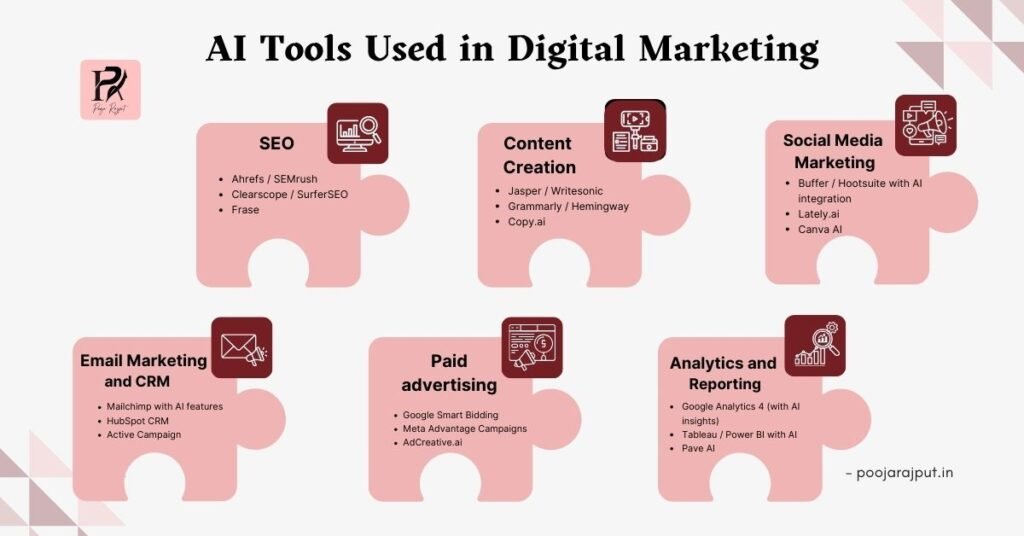
1. AI Tools for SEO and Content Optimisation
SEO is one of the most data-heavy areas in digital marketing. AI-powered tools help marketers make smarter decisions in less time. Common AI SEO tools:
- Ahrefs / SEMrush: Analyses keywords, backlinks, and competitor strategies
- Clearscope / SurferSEO: Suggests content optimisations based on search intent
- Frase: Helps structure content and find relevant topics
How beginners can use these tools:
- Research keywords efficiently
- Find topics users are actually searching for
- Optimise content for better rankings without guesswork
2. AI Tools for Content Creation
AI can also assist in creating content faster while keeping it relevant. Popular tools:
- Jasper / Writesonic: Helps generate ideas and write blog sections
- Grammarly / Hemingway: Improves readability, grammar, and tone
- Copy.ai: Creates social media captions, email content, and ads
How it helps students and beginners:
- Saves time while creating content
- Offers suggestions for headlines, meta descriptions, and blog structures
- Ensures content is engaging and SEO-friendly
3. AI Tools for Social Media Marketing
Social media platforms rely heavily on AI for engagement. Marketers can also use AI tools to boost results. The tools are:
- Buffer / Hootsuite with AI integration: Suggests best posting times
- Lately.ai: Analyses which posts perform best and creates content suggestions
- Canva AI: Generates social media visuals quickly
How AI helps:
- Optimises posting schedule for maximum reach
- Analyses audience behaviour to improve engagement
- Suggests trending topics or hashtags.
4. AI Tools for Email Marketing and CRM
Email marketing is powerful when personalised, and AI makes it even more effective. AI tools:
- Mailchimp with AI features: Segment users, personalise subject lines, and send at optimal times
- HubSpot CRM: Uses AI to track leads and suggest actions
- Active Campaign: Automates email campaigns based on user behaviour
How beginners can benefit:
- Automatically segment users based on interests
- Increase email open rates and click-throughs
- Save hours of manual work
5. AI Tools for Paid Advertising
AI is deeply integrated into ad platforms like Google Ads and Facebook Ads. Popular AI-powered features:
- Google Smart Bidding: Adjusts bids in real time for best ROI
- Meta Advantage Campaigns: Automatically targets high-performing audiences
- AdCreative.ai: Generates ad creatives and tests multiple variations
How AI helps:
- Optimises campaigns without manual guesswork
- Reduces wasted ad spend
- Improves conversion rates
6. AI Tools for Analytics and Reporting
Analytics is another area where AI shines. It helps marketers make sense of massive amounts of data. Following are the popular tools:
- Google Analytics 4 (with AI insights): Predicts user behaviour and trends
- Tableau / Power BI with AI: Creates dashboards and visualises data
- Pave AI: Converts Google Analytics data into actionable marketing insights
Benefits:
- Quick identification of trends
- Predictive analytics to anticipate user needs
- Automated reporting for smarter decisions
Example: A student analysing a website’s traffic can use AI tools to identify which pages attract the most engaged visitors and what improvements can increase conversions.
Benefits of AI in Digital Marketing
The rise of AI has completely changed how businesses approach digital marketing. Understanding the benefits of AI in digital marketing is crucial for students and career switchers who want to build a future-proof skill set. AI doesn’t just make marketing faster—it makes it smarter, more personalised, and more efficient.
Let’s explore the key benefits in detail.
1. Better Decision-Making Using Data
One of the biggest advantages of AI is its ability to process huge amounts of data quickly.
AI tools can analyse:
- Customer behaviour
- Content engagement
- Ad performance
- Conversion patterns
Instead of guessing which campaigns might work, marketers get data-driven insights.
Example: A student running a small digital marketing project can use AI to find which blog posts attract the most traffic and which social media posts generate the most engagement. This allows them to focus on strategies that actually work.
2. Improved Personalisation
Modern customers expect content and offers tailored to their interests. For students, learning how to implement personalisation using AI tools is a highly valuable skill. AI makes this possible at scale.
AI can:
- Personalise website experiences for individual users
- Recommend products based on past behaviour
- Send emails with content that matches each subscriber’s interests
3. Time and Cost Efficiency
AI automates repetitive and time-consuming tasks, which saves both time and money. Tasks AI can handle include:
- Campaign optimisation
- A/B testing for ads
- Data collection and reporting
- Social media posting
4. Enhanced Customer Experience
AI improves customer satisfaction by providing quick, relevant, and personalised experiences. Applications include:
- Chatbots for instant support
- AI-generated product recommendations
- Automated follow-ups
5. Scalable Marketing Growth
AI allows businesses to scale campaigns without scaling effort.
Even with thousands or millions of users, AI can:
- Analyse behaviour
- Optimise campaigns
- Personalise communication
Example: A small business expanding online can use AI-driven ads and email campaigns to reach more people without hiring a large marketing team.
This is why intelligent automation is considered a game-changer for online growth.
6. Predictive Marketing
AI doesn’t just analyse past behaviour—it predicts future actions.
Marketers can anticipate:
- Which leads are most likely to convert
- What products users may buy next
- When users may stop engaging
7. Better ROI and Budget Control
AI ensures marketing budgets are used effectively.
- AI optimises ad spend by allocating more budget to high-performing campaigns
- Reduces waste on low-performing channels
- Improves overall return on investment (ROI)
8. Real-Time Campaign Optimisation
Traditional marketing decisions often take hours or days. AI works in real-time.
- Adjusts campaigns instantly
- Monitors performance continuously
- Makes suggestions or takes automated actions
Challenges and Limitations of AI in Digital Marketing
While AI offers huge benefits, it’s important to understand that it is not perfect. For students and career switchers, knowing the challenges helps you set realistic expectations and prepare better.
AI in digital marketing comes with its own limitations that every beginner should be aware of.
1. Data Dependency
AI relies heavily on data quality and quantity.
- Poor or incomplete data can lead to inaccurate insights.
- AI cannot generate results from guesswork—it needs real information.
2. Lack of Human Creativity and Emotion
AI can analyse patterns and predict behaviour, but it cannot fully understand human emotions or creativity.
- AI can’t craft content with humour, empathy, or cultural context on its own.
- Emotional storytelling, brand voice, and unique campaigns still need human input
3. Privacy and Ethical Concerns
AI uses large amounts of user data to make decisions. This raises privacy and ethical challenges:
- Misusing personal data can lead to legal issues
- Customers may feel uncomfortable if marketing is too intrusive
- Ethical AI use is essential for long-term brand trust
4. Cost of Advanced AI Tools
Some AI tools can be expensive for small businesses or beginners:
- Advanced platforms may require monthly subscriptions
- Free versions are often limited in features
- Companies need to balance tool costs with expected benefits
5. Over-Reliance on AI
Another limitation is the risk of depending too much on AI:
- AI is a support tool, not a replacement for strategy
- Marketers must still define goals, messaging, and creative ideas
- Blind reliance may lead to repetitive or irrelevant campaigns
AI vs Traditional Digital Marketing
To understand the true impact of AI in digital marketing, it’s helpful to compare it with traditional methods. While traditional marketing still works, AI-driven marketing has completely changed the way campaigns are planned, executed, and optimised.
Here’s a simple comparison for beginners:
1. Traditional Digital Marketing
Traditional digital marketing relies heavily on manual processes and human intuition:
- Campaign planning and optimisation are often based on past experience
- Targeting is broad and generic
- Analysing performance can take days or weeks
- Personalisation is limited
- Reporting and insights require manual work
While this approach works, it is time-consuming, less accurate, and harder to scale.
2. AI-Powered Digital Marketing
AI-powered marketing uses intelligent automation, data analysis, and predictive insights to optimise campaigns in real-time:
- Analyses massive amounts of data instantly
- Delivers highly personalised content and ads
- Continuously optimises campaigns for better results
- Predicts customer behaviour and preferences
- Automates repetitive tasks, saving time and resources
Key Differences
| Aspect | Traditional Marketing | AI-Powered Marketing |
|---|---|---|
| Data Analysis | Manual, slow, limited | Real-time, accurate, predictive |
| Personalisation | Generic messaging for broad audiences | Highly personalised content and ads tailored to individual users |
| Speed | Slow, with manual analysis and reporting | Fast, with automated analysis and instant optimisations |
| Decision-Making | Mostly based on past experience and gut feeling | Data-driven, predictive, and smarter decisions in real-time |
| Scalability | Limited; adding campaigns or audiences takes time. | Easy to scale across large audiences without extra effort |
| Efficiency | Time-consuming; repetitive tasks done manually | Saves time by automating repetitive work |
Real-World Examples of AI in Digital Marketing
You already interact with AI daily, even if you don’t realise it.
Examples:
- Netflix recommending shows
- Amazon suggesting products
- Google showing relevant ads
- Instagram deciding which posts you see
All these platforms use AI to drive engagement and growth
How Businesses Can Implement AI in Their Digital Marketing Strategy
For beginners, it’s one thing to read about AI, but it’s another to see how businesses actually apply it. Implementing AI doesn’t have to be complicated. Even small steps can make a big difference in results.
Basic Steps to Implement AI
- Define marketing goals
- Choose the right AI tools
- Integrate with existing platforms
- Train the team
- Monitor and optimise continuously
Future of AI in Digital Marketing
The future of AI in digital marketing looks very promising. For students and career switchers, this means new opportunities and exciting career paths.
Upcoming Trends
- Hyper-Personalisation
AI will make marketing experiences more personalised than ever. Imagine every user seeing content, ads, and recommendations that perfectly match their preferences and behaviour. - Voice and Visual Search
With voice assistants and visual search gaining popularity, AI will optimise content for natural language queries and image-based searches. Marketers will need to adapt SEO strategies for this new era. - Predictive Marketing
AI will increasingly predict customer behaviour, helping businesses anticipate needs, prevent churn, and send the right message at the right time. - AI-Human Collaboration
AI won’t replace humans. Instead, marketers will work alongside AI tools to enhance creativity, strategy, and efficiency. Students who learn how to leverage AI alongside their skills will have a strong advantage in the job market.
Skills Marketers Need in an AI-Driven World
To build a successful career in AI-powered digital marketing, students and career switchers should focus on the following skills:
- Data Understanding
Learn how to interpret data, identify patterns, and make decisions based on insights. AI can analyse data, but humans need to strategize and act. - SEO and Analytics
AI tools can optimise SEO and track performance, but understanding the fundamentals ensures you can use the tools effectively. - AI Tool Usage
Gain hands-on experience with AI tools for content, social media, email, analytics, and ads. Practical knowledge is more valuable than just theory. - Strategic Thinking
AI can automate tasks, but only humans can create effective campaigns, messaging, and long-term strategies. - Continuous Learning
AI is evolving rapidly. Stay updated with trends, new tools, and best practices to remain competitive.
AI will not replace marketers, but marketers who use AI effectively will have a distinct career advantage. For students, starting early with AI skills can open doors to internships, freelance projects, and high-demand job roles
Career Opportunities in AI-Driven Digital Marketing
If you are a student or planning a career switch, AI has created new roles instead of removing jobs.
Popular Job Roles in AI Digital Marketing include:
- AI Digital Marketing Executive
- Performance Marketing Specialist
- SEO Analyst with AI Tools
- Marketing Automation Specialist
- CRM and Email Marketing Manager
- Growth Marketer
How AI Is Transforming Online Growth Long-Term
The biggest impact of AI is long-term growth.
AI helps businesses:
- Understand customers deeply
- Build long-term relationships
- Improve brand loyalty
- Scale marketing operations smoothly
This is why AI in digital marketing: how intelligent automation is transforming online growth is not just a headline, but a reality
Final Conclusion: Why Learning AI in Digital Marketing Is a Smart Career Move
AI is not here to scare marketers. It is here to empower them.
For students and career switchers, learning AI-driven digital marketing is one of the smartest career decisions today. Intelligent automation saves time, improves results, and opens doors to better job opportunities.
Those who combine marketing fundamentals with AI tools will lead the future of digital marketing.
The earlier you start learning, the stronger your advantage will be.